Junior college (Class 11-12)

Class 11 previous year questions (PYQ)

58,391 previous year Class 11 questions, grouped by year, with answers and solutions.

2026 (3333 questions)

Q1.

Directions: In the question below, a statement of Assertion (A) is followed by a statement of Reason (R). Choose the correct option:

Assertion (A): Systemic arteries have thick, elastic muscular walls compared to veins.

Reason (R): Arterial blood flows under high, pulsatile hydrostatic pressure generated by ventricular systole.


(A)
Both Assertion (A) and Reason (R) are true and Reason (R) is the correct explanation of Assertion (A).
(B)
Both Assertion (A) and Reason (R) are true but Reason (R) is not the correct explanation of Assertion (A).
(C)
Assertion (A) is true but Reason (R) is false.
(D)
Assertion (A) is false but Reason (R) is true.
Show answer & solution
Verified Answer & Solution Locked
Sign in to your free student account to reveal verified answers and step-by-step solutions.
Sign in to view
Q2.

Refer to the Case Study 'Case Study: Parabolic Cable Geometry in Civil Engineering Suspension Bridges' to answer:

What is the vertical height of the suspension cable at a horizontal distance of $25\text{ m}$ from the bridge center?


(A)
$y = 0.008(25)^2 + 5 = 0.008(625) + 5 = 5 + 5 = 10\text{ m}$
(B)
$y = 15\text{ m}$
(C)
$y = 12.5\text{ m}$
(D)
$y = 8\text{ m}$
Show answer & solution
Verified Answer & Solution Locked
Sign in to your free student account to reveal verified answers and step-by-step solutions.
Sign in to view

2025 (4435 questions)

Q1.

Which hormone inhibits morphogenesis?  

(A)
ABA
(B)
2,4-D
(C)
NAA
(D)
IBA
Show answer & solution
Verified Answer & Solution Locked
Sign in to your free student account to reveal verified answers and step-by-step solutions.
Sign in to view
Q2.

Which part of the brain is responsible for thermoregulation?  

(A)
Medulla oblongata
(B)
Cerebrum
(C)
Hypothalamus
(D)
Corpus callosum
Show answer & solution
Verified Answer & Solution Locked
Sign in to your free student account to reveal verified answers and step-by-step solutions.
Sign in to view

2024 (6305 questions)

Q1.

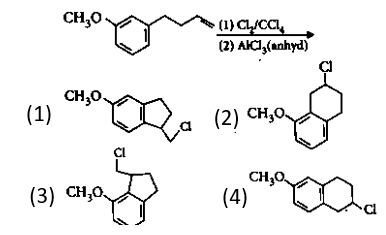
The main product of the following reaction is

Show answer & solution
Verified Answer & Solution Locked
Sign in to your free student account to reveal verified answers and step-by-step solutions.
Sign in to view
Q2.

Identify the step in the tricarboxylic acid cycle,which does not involve oxidation of the substrate.

(A)
Succinic acid $\rightarrow$ Malic acid
(B)
Succinyl-$CoA$ $\rightarrow$ Succinic acid
(C)
Isocitrate $\rightarrow \alpha$-ketoglutaric acid
(D)
Malic acid $\rightarrow$ Oxaloacetic acid
Show answer & solution
Verified Answer & Solution Locked
Sign in to your free student account to reveal verified answers and step-by-step solutions.
Sign in to view

2023 (4410 questions)

Q1.

Which activity from the following is exhibited by a $Lewis$ base according to its definition?

(A)
Accept a pair of electrons
(B)
Donate a pair of electrons
(C)
Accept $H^{+}$ ions
(D)
Donate $OH^{-}$ ions
Show answer & solution
Verified Answer & Solution Locked
Sign in to your free student account to reveal verified answers and step-by-step solutions.
Sign in to view
Q2.

Which of the following reactions is not correct?

(A)
$CH_2Br-CH_2Br \xrightarrow{Zn} CH_2=CH_2$
(B)
$CH_3-C \equiv C-CH_3 \xrightarrow{H_2, Pd/BaSO_4} cis-CH_3-CH=CH-CH_3$
(C)
$CH_3-C \equiv CH \xrightarrow{Hg^{2+}, H^+} CH_3-CO-CH_3$
(D)
$Ph-CH_2-Br \xrightarrow{Na, \text{dry ether}} Ph-CH_2-CH_2-Ph$
Show answer & solution
Verified Answer & Solution Locked
Sign in to your free student account to reveal verified answers and step-by-step solutions.
Sign in to view

2022 (4453 questions)

Q1.

Which of the following statements with respect to endoplasmic reticulum is incorrect?

(A)
RER has ribosomes attached to ER
(B)
SER is devoid of ribosomes
(C)
In prokaryotes only RER are present
(D)
SER are the sites for lipid synthesis
Show answer & solution
Verified Answer & Solution Locked
Sign in to your free student account to reveal verified answers and step-by-step solutions.
Sign in to view
Q2.

A car accelerates from rest at a constant rate of \(2\ \text{m/s}^2\) for some time. Then, it retards at a constant rate of \(4\ \text{m/s}^2\) and comes to rest. If the total time for which it remains in motion is \(3\ \text{s}\), what is the total distance travelled?

(A)
\(2\ \text{m}\)
(B)
\(3\ \text{m}\)
(C)
\(4\ \text{m}\)
(D)
\(6\ \text{m}\)
Show answer & solution
Verified Answer & Solution Locked
Sign in to your free student account to reveal verified answers and step-by-step solutions.
Sign in to view

2021 (4640 questions)

Q1.

Through the point $(4, 5)$,a straight line is drawn making positive intercepts on the coordinate axes. The area of the triangle thus formed is least,when the ratio of the intercepts on the $X$ and $Y$ axes is

(A)
$1 : 1$
(B)
$3 : 4$
(C)
$4 : 5$
(D)
$2 : 3$
Show answer & solution
Verified Answer & Solution Locked
Sign in to your free student account to reveal verified answers and step-by-step solutions.
Sign in to view
Q2.

If $(4,7)$ and $(-2,-1)$ are ends of a diameter of a circle which intersects $X$-axis at $A$ and $B$,then $AB$ is equal to

(A)
$5$
(B)
$6$
(C)
$7$
(D)
$8$
Show answer & solution
Verified Answer & Solution Locked
Sign in to your free student account to reveal verified answers and step-by-step solutions.
Sign in to view

2020 (4619 questions)

Q1.

A gas is compressed adiabatically, which one of the following statement is NOT true.  

(A)
There is no heat supplied to the system.
(B)
There is no change in the internal energy.
(C)
The temperature of the gas increases.
(D)
The change in the internal energy is equal to the work done on the gas.
Show answer & solution
Verified Answer & Solution Locked
Sign in to your free student account to reveal verified answers and step-by-step solutions.
Sign in to view
Q2.

The increasing order of reactivity of alkaline earth metals with water is

(A)
$Mg \lt Sr \lt Ca \lt Ba$
(B)
$Ba \lt Mg \lt Ca \lt Sr$
(C)
$Ba \lt Sr \lt Ca \lt Mg$
(D)
$Mg \lt Ca \lt Sr \lt Ba$
Show answer & solution
Verified Answer & Solution Locked
Sign in to your free student account to reveal verified answers and step-by-step solutions.
Sign in to view

2019 (3565 questions)

Q1.

Let the length of the latus rectum of an ellipse with its major axis along the $x$-axis and center at the origin be $8$. If the distance between the foci of this ellipse is equal to the length of its minor axis,then which one of the following points lies on it?

(A)
$(4, 2\sqrt{2})$
(B)
$(4\sqrt{3}, 2\sqrt{2})$
(C)
$(4\sqrt{3}, 2\sqrt{3})$
(D)
$(4, 2\sqrt{3})$
Show answer & solution
Verified Answer & Solution Locked
Sign in to your free student account to reveal verified answers and step-by-step solutions.
Sign in to view
Q2.

The transverse section of a plant shows following anatomical features:  
(a) Large number of scattered vascular bundles surrounded by bundle sheath.  
(b) Large conspicuous parenchymatous ground tissue.  
(c) Vascular bundles conjoint and closed.  
(d) Phloem parenchyma absent.  
Identify the category of plant and its part:  

(A)
Dicotyledonous root
(B)
Monocotyledonous stem
(C)
Monocotyledonous root
(D)
Dicotyledonous stem
Show answer & solution
Verified Answer & Solution Locked
Sign in to your free student account to reveal verified answers and step-by-step solutions.
Sign in to view

2018 (2721 questions)

Q1.

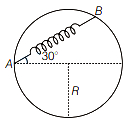
$A$ bead of mass $m = 100 \,g$ is attached to one end of a spring of natural length $L$ and spring constant $k = \frac{(\sqrt{3}+1) mg}{L}$. The other end of the spring is fixed at point $A$ on a smooth vertical ring of radius $R$. The bead is at point $B$ such that the spring makes an angle of $30^{\circ}$ with the horizontal diameter. The normal reaction at $B$ just after it is released to move is (take $g = 9.8 \,ms^{-2}$): (in $\,N$)

figure

(A)
$1.73$
(B)
$2.23$
(C)
$2.44$
(D)
$2.55$
Show answer & solution
Verified Answer & Solution Locked
Sign in to your free student account to reveal verified answers and step-by-step solutions.
Sign in to view
Q2.

The normal at a point $\theta$ to the curve $x=a(1+\cos \theta), y=a \sin \theta$ always passes through the fixed point

(A)
$(0, a)$
(B)
$(2 a, 0)$
(C)
$(a, 0)$
(D)
$(a, a)$
Show answer & solution
Verified Answer & Solution Locked
Sign in to your free student account to reveal verified answers and step-by-step solutions.
Sign in to view

2017 (2470 questions)

Q1.

The converse of \(((\sim p) \wedge q) \Rightarrow r\) is  

(A)
\((\sim r) \Rightarrow p \wedge q\)
(B)
\(((\sim p) \vee q) \Rightarrow r\)
(C)
\((p \vee (\sim q)) \Rightarrow (\sim r)\)
(D)
\((\sim r) \Rightarrow ((\sim p) \wedge q)\)
Show answer & solution
Verified Answer & Solution Locked
Sign in to your free student account to reveal verified answers and step-by-step solutions.
Sign in to view
Q2.

In the manufacture of hydrogen from water gas $(CO + H_2)$,which of the following is the correct statement?

(A)
$CO$ is oxidized to $CO_2$ with steam in the presence of a catalyst followed by absorption of $CO_2$ in alkali.
(B)
$CO$ and $H_2$ are separated based on the difference in their densities.
(C)
Hydrogen is isolated by diffusion.
(D)
$H_2$ is removed by occlusion with $Pd$.
Show answer & solution
Verified Answer & Solution Locked
Sign in to your free student account to reveal verified answers and step-by-step solutions.
Sign in to view

2016 (2062 questions)

Q1.

The sum of all $4$-digit numbers that can be formed using the digits $2, 3, 4, 5, 6$ without repetition is:

(A)
$533820$
(B)
$532280$
(C)
$533280$
(D)
$532380$
Show answer & solution
Verified Answer & Solution Locked
Sign in to your free student account to reveal verified answers and step-by-step solutions.
Sign in to view
Q2.

A solid sphere is rotating freely about its symmetry axis in free space. The radius of the sphere is increased keeping its mass same. Which of the following physical quantities would remain constant for the sphere?

(A)
Angular velocity
(B)
Moment of inertia
(C)
Rotational kinetic energy
(D)
Angular momentum
Show answer & solution
Verified Answer & Solution Locked
Sign in to your free student account to reveal verified answers and step-by-step solutions.
Sign in to view

2015 (2076 questions)

Q1.

Which statements(s) is (are) false for the periodic classification of elements?

(A)
The properties of the elements are the periodic functions of their atomic numbers.
(B)
Non-metallic elements are lesser in number than the metallic elements.
(C)
The first ionization energies of the elements along a period do not vary in a regular manner with increase in atomic number.
(D)
For transition elements, the d-electrons are filled monotonically with increase in atomic number.
(E)
Both (3) and (4).
Show answer & solution
Verified Answer & Solution Locked
Sign in to your free student account to reveal verified answers and step-by-step solutions.
Sign in to view
Q2.

In a data,if the number $i$ is repeated $i$ times for $i=1, 2, \ldots, n$,then the mean of the data is

(A)
$\frac{2n+1}{6}$
(B)
$\frac{2n+1}{4}$
(C)
$\frac{2n+1}{3}$
(D)
$\frac{2n+1}{2}$
Show answer & solution
Verified Answer & Solution Locked
Sign in to your free student account to reveal verified answers and step-by-step solutions.
Sign in to view

2014 (925 questions)

Q1.

The locus of the foot of the perpendicular drawn from the centre of the ellipse $x^2 + 3y^2 = 6$ to any tangent to it is:

(A)
$(x^2 + y^2)^2 = 6x^2 + 2y^2$
(B)
$(x^2 + y^2)^2 = 6x^2 - 2y^2$
(C)
$(x^2 - y^2)^2 = 6x^2 + 2y^2$
(D)
$(x^2 - y^2)^2 = 6x^2 - 2y^2$
Show answer & solution
Verified Answer & Solution Locked
Sign in to your free student account to reveal verified answers and step-by-step solutions.
Sign in to view
Q2.

Density of carbon monoxide is maximum at

(A)
$0.5 \ atm$ and $273 \ K$
(B)
$4 \ atm$ and $500 \ K$
(C)
$2 \ atm$ and $600 \ K$
(D)
$6 \ atm$ and $1092 \ K$
Show answer & solution
Verified Answer & Solution Locked
Sign in to your free student account to reveal verified answers and step-by-step solutions.
Sign in to view

2013 (967 questions)

Q1.

Accumulation of lactic acid $(HC_3H_5O_3),$ a monobasic acid in tissues,leads to pain and a feeling of fatigue. In a $0.10 \ M$ aqueous solution,lactic acid is $3.7 \%$ dissociated. The value of the dissociation constant,$K_a,$ for this acid will be:

(A)
$1.4 \times 10^{-5}$
(B)
$1.4 \times 10^{-4}$
(C)
$3.7 \times 10^{-4}$
(D)
$2.8 \times 10^{-4}$
Show answer & solution
Verified Answer & Solution Locked
Sign in to your free student account to reveal verified answers and step-by-step solutions.
Sign in to view
Q2.

Which of the following represents the correct order of increasing first ionization enthalpy for $Ca, Ba, S, Se$ and $Ar$?

(A)
$Ca \lt S \lt Ba \lt Se \lt Ar$
(B)
$S \lt Se \lt Ca \lt Ba \lt Ar$
(C)
$Ba \lt Ca \lt Se \lt S \lt Ar$
(D)
$Ca \lt Ba \lt S \lt Se \lt Ar$
Show answer & solution
Verified Answer & Solution Locked
Sign in to your free student account to reveal verified answers and step-by-step solutions.
Sign in to view

2012 (1004 questions)

Q1.

An open vessel at $300 \ K$ is heated until $2/5$ of the air in it is expelled. Assuming that the volume of the vessel remains constant,the temperature to which the vessel is heated is $..... \ K$.

(A)
$1500$
(B)
$400$
(C)
$500$
(D)
$750$
Show answer & solution
Verified Answer & Solution Locked
Sign in to your free student account to reveal verified answers and step-by-step solutions.
Sign in to view
Q2.

The statement that is $TRUE$ among the following is:

(A)
The contrapositive of $3x + 2 = 8 \Rightarrow x = 2$ is $x \neq 2 \Rightarrow 3x + 2 \neq 8$.
(B)
The converse of $\tan x = 0 \Rightarrow x = 0$ is $x \neq 0 \Rightarrow \tan x = 0$.
(C)
$p \Rightarrow q$ is equivalent to $p \vee \sim q$.
(D)
$p \vee q$ and $p \wedge q$ have the same truth table.
Show answer & solution
Verified Answer & Solution Locked
Sign in to your free student account to reveal verified answers and step-by-step solutions.
Sign in to view

2011 (830 questions)

Q1.

$A$ box is moved along a straight line by a machine delivering constant power. The distance moved by the body in time $t$ is proportional to

(A)
$t^{\frac{1}{2}}$
(B)
$t^{\frac{3}{4}}$
(C)
$t^{\frac{3}{2}}$
(D)
$t^2$
Show answer & solution
Verified Answer & Solution Locked
Sign in to your free student account to reveal verified answers and step-by-step solutions.
Sign in to view
Q2.

The decreasing order of wavelength of infrared,microwave,ultraviolet,and gamma rays is:

(A)
microwave,infrared,ultraviolet,gamma rays
(B)
gamma rays,ultraviolet,infrared,microwaves
(C)
microwaves,gamma rays,infrared,ultraviolet
(D)
infrared,microwave,ultraviolet,gamma rays
Show answer & solution
Verified Answer & Solution Locked
Sign in to your free student account to reveal verified answers and step-by-step solutions.
Sign in to view

2010 (807 questions)

Q1.

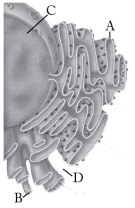
Identify the components labelled $A, B, C$ and $D$ in the diagram below from the list $(i)$ to $(viii)$ given along with:
Components:
$(i)$ Cristae of mitochondria
$(ii)$ Inner membrane of mitochondria
$(iii)$ Cytoplasm
$(iv)$ Smooth endoplasmic reticulum
$(v)$ Rough endoplasmic reticulum
$(vi)$ Mitochondrial matrix
$(vii)$ Cell vacuole
$(viii)$ Nucleus
The correct components are:

figure

(A)
$(A)-(v), (B)-(iv), (C)-(viii), (D)-(iii)$
(B)
$(A)-(i), (B)-(iv), (C)-(viii), (D)-(vi)$
(C)
$(A)-(vi), (B)-(v), (C)-(iv), (D)-(vii)$
(D)
$(A)-(v), (B)-(i), (C)-(iii), (D)-(ii)$
Show answer & solution
Verified Answer & Solution Locked
Sign in to your free student account to reveal verified answers and step-by-step solutions.
Sign in to view
Q2.

$A$ buffer solution contains $0.1 \ mol$ of sodium acetate in $1000 \ cm^{3}$ of $0.1 \ M$ acetic acid. To the above buffer solution,$0.1 \ mol$ of sodium acetate is further added and dissolved. The $pH$ of the resulting buffer is equal to

(A)
$pK_{a} - \log 2$
(B)
$pK_{a}$
(C)
$pK_{a} + 2$
(D)
$pK_{a} + \log 2$
Show answer & solution
Verified Answer & Solution Locked
Sign in to your free student account to reveal verified answers and step-by-step solutions.
Sign in to view

2009 (818 questions)

Q1.

From the following bond energies:

$H-H$ bond energy$431.37 \text{ kJ mol}^{-1}$
$C=C$ bond energy$606.10 \text{ kJ mol}^{-1}$
$C-C$ bond energy$336.49 \text{ kJ mol}^{-1}$
$C-H$ bond energy$410.50 \text{ kJ mol}^{-1}$

Enthalpy for the reaction $CH_2=CH_2 + H-H \to CH_3-CH_3$ will be .............. $\text{kJ mol}^{-1}$

(A)
$-243.6$
(B)
$-120$
(C)
$553$
(D)
$1523.6$
Show answer & solution
Verified Answer & Solution Locked
Sign in to your free student account to reveal verified answers and step-by-step solutions.
Sign in to view
Q2.

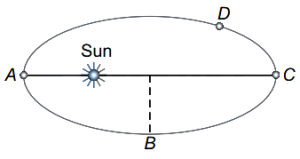
$A$ planet revolves around the sun in an elliptical orbit. The linear speed of the planet will be maximum at

figure

(A)
$D$
(B)
$B$
(C)
$A$
(D)
$C$
Show answer & solution
Verified Answer & Solution Locked
Sign in to your free student account to reveal verified answers and step-by-step solutions.
Sign in to view

2008 (576 questions)

Q1.

The alkali metals form salt-like hydrides by direct synthesis at elevated temperatures. The thermal stability of these hydrides decreases in which of the following orders?

(A)
$NaH \gt LiH \gt KH \gt RbH \gt CsH$
(B)
$LiH \gt NaH \gt KH \gt RbH \gt CsH$
(C)
$CsH \gt RbH \gt KH \gt NaH \gt LiH$
(D)
$KH \gt NaH \gt LiH \gt CsH \gt RbH$
Show answer & solution
Verified Answer & Solution Locked
Sign in to your free student account to reveal verified answers and step-by-step solutions.
Sign in to view
Q2.

The velocity of electromagnetic radiation in a medium of permittivity $\varepsilon_0$ and permeability $\mu_0$ is given by:

(A)
$\sqrt{\frac{1}{\mu_0 \varepsilon_0}}$
(B)
$\sqrt{\frac{\mu_0}{\varepsilon_0}}$
(C)
$\sqrt{\frac{\varepsilon_0}{\mu_0}}$
(D)
$\sqrt{\mu_0 \varepsilon_0}$
Show answer & solution
Verified Answer & Solution Locked
Sign in to your free student account to reveal verified answers and step-by-step solutions.
Sign in to view

2007 (598 questions)

Q1.

$A$ plant requires magnesium for

(A)
protein synthesis
(B)
chlorophyll synthesis
(C)
cell wall development
(D)
holding cells together
Show answer & solution
Verified Answer & Solution Locked
Sign in to your free student account to reveal verified answers and step-by-step solutions.
Sign in to view
Q2.

Calculate the change in internal energy $(\Delta U)$ if $\Delta H = -92.2\, kJ$,$P = 40\, atm$,and $\Delta V = -1\, L$.

(A)
$-42\, kJ$
(B)
$-88\, kJ$
(C)
$+88\, kJ$
(D)
$+42\, kJ$
Show answer & solution
Verified Answer & Solution Locked
Sign in to your free student account to reveal verified answers and step-by-step solutions.
Sign in to view

2006 (413 questions)

Q1.

Observe the following statements:
$I$. The circle $x^2+y^2-6x-4y-7=0$ touches the $y$-axis.
$II$. The circle $x^2+y^2+6x+4y-7=0$ touches the $x$-axis.
Which of the following is a correct statement?

(A)
Both $I$ and $II$ are true
(B)
Neither $I$ nor $II$ is true
(C)
$I$ is true,$II$ is false
(D)
$I$ is false,$II$ is true
Show answer & solution
Verified Answer & Solution Locked
Sign in to your free student account to reveal verified answers and step-by-step solutions.
Sign in to view
Q2.

Two solid spheres $A$ and $B$ made of the same material have radii $r_A$ and $r_B$ respectively. Both the spheres are cooled from the same temperature under the conditions valid for Newton's law of cooling. The ratio of the rate of change of temperature of $A$ and $B$ is :

(A)
$r_A / r_B$
(B)
$r_B / r_A$
(C)
$r_A^2 / r_B^2$
(D)
$r_B^2 / r_A^2$
Show answer & solution
Verified Answer & Solution Locked
Sign in to your free student account to reveal verified answers and step-by-step solutions.
Sign in to view

2005 (539 questions)

Q1.

Which one of the following statements regarding enzyme inhibition is correct?

(A)
Competitive inhibition is seen when a substrate competes with an enzyme for binding to an inhibitor protein.
(B)
Competitive inhibition is seen when the substrate and the inhibitor compete for the active site on the enzyme.
(C)
Non-competitive inhibition of an enzyme can be overcome by adding large amount of substrate.
(D)
Non-competitive inhibitors often bind to the enzyme irreversibly.
Show answer & solution
Verified Answer & Solution Locked
Sign in to your free student account to reveal verified answers and step-by-step solutions.
Sign in to view
Q2.

An electron is moving in Bohr's fourth orbit. Its de-Broglie wavelength is $\lambda$. What is the circumference of the fourth orbit?

(A)
$2 / \lambda$
(B)
$2 \lambda$
(C)
$4 \lambda$
(D)
$4 / \lambda$
Show answer & solution
Verified Answer & Solution Locked
Sign in to your free student account to reveal verified answers and step-by-step solutions.
Sign in to view

2004 (567 questions)

Q1.

The shape of $O_2F_2$ is similar to that of

(A)
$C_2F_2$
(B)
$H_2O_2$
(C)
$H_2F_2$
(D)
$C_2H_2$
Show answer & solution
Verified Answer & Solution Locked
Sign in to your free student account to reveal verified answers and step-by-step solutions.
Sign in to view
Q2.

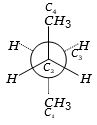
In the given conformation,if $C_2$ is rotated about the $C_2-C_3$ bond anticlockwise by an angle of $120^{\circ}$,then the conformation obtained is:

figure

(A)
Fully eclipsed conformation
(B)
Partially eclipsed conformation
(C)
Gauche conformation
(D)
Staggered conformation
Show answer & solution
Verified Answer & Solution Locked
Sign in to your free student account to reveal verified answers and step-by-step solutions.
Sign in to view

2003 (507 questions)

Q1.

The focal chord to $y^2 = 16x$ is tangent to $(x - 6)^2 + y^2 = 2$. Then,the possible values of the slope of this chord are:

(A)
$\{-1, 1\}$
(B)
$\{-2, 2\}$
(C)
$\{-2, 1/2\}$
(D)
$\{2, -1/2\}$
Show answer & solution
Verified Answer & Solution Locked
Sign in to your free student account to reveal verified answers and step-by-step solutions.
Sign in to view
Q2.

Assertion : $trans-2-Butene$ on reaction with $Br_2$ gives $meso-2,3-dibromobutane$.
Reason : The reaction involves $syn-addition$ of bromine.

(A)
If both Assertion and Reason are correct and the Reason is a correct explanation of the Assertion.
(B)
If both Assertion and Reason are correct but Reason is not a correct explanation of the Assertion.
(C)
If the Assertion is correct but Reason is incorrect.
(D)
If both the Assertion and Reason are incorrect.
Show answer & solution
Verified Answer & Solution Locked
Sign in to your free student account to reveal verified answers and step-by-step solutions.
Sign in to view

2002 (600 questions)

Q1.

Which type of cartilage is found at the ends of long bones?

(A)
Calcified cartilage
(B)
Hyaline cartilage
(C)
Elastic cartilage
(D)
Fibrous cartilage
Show answer & solution
Verified Answer & Solution Locked
Sign in to your free student account to reveal verified answers and step-by-step solutions.
Sign in to view
Q2.

In a compound,$C$,$H$,and $N$ atoms are present in $9 : 1 : 3.5$ by weight. The molecular weight of the compound is $108$. What is the molecular formula of the compound?

(A)
$C_2H_6N_2$
(B)
$C_3H_4N$
(C)
$C_6H_8N_2$
(D)
$C_9H_{12}N_3$
Show answer & solution
Verified Answer & Solution Locked
Sign in to your free student account to reveal verified answers and step-by-step solutions.
Sign in to view

2001 (514 questions)

Q1.

Two particles having mass $M$ and $m$ are moving in a circular path having radius $R$ and $r$. If their time periods are the same,then the ratio of their angular velocities will be:

(A)
$1$
(B)
$\frac{r}{R}$
(C)
$\frac{R}{r}$
(D)
$\sqrt{\frac{R}{r}}$
Show answer & solution
Verified Answer & Solution Locked
Sign in to your free student account to reveal verified answers and step-by-step solutions.
Sign in to view
Q2.

In a $\triangle ABC$,the expression $\frac{\cos C+\cos A}{c+a}+\frac{\cos B}{b}$ is equal to

(A)
$\frac{1}{a}$
(B)
$\frac{1}{b}$
(C)
$\frac{c+a}{b}$
(D)
$1$
Show answer & solution
Verified Answer & Solution Locked
Sign in to your free student account to reveal verified answers and step-by-step solutions.
Sign in to view

2000 (317 questions)

Q1.

Plants absorb $Zn$ in the form of:

(A)
$Zn$
(B)
$Zn^{2+}$
(C)
$ZnO$
(D)
$ZnSO_4$
Show answer & solution
Verified Answer & Solution Locked
Sign in to your free student account to reveal verified answers and step-by-step solutions.
Sign in to view
Q2.

Which of the following has the highest nucleophilicity?

(A)
$F^-$
(B)
$OH^-$
(C)
$CH_3^-$
(D)
$NH_2^-$
Show answer & solution
Verified Answer & Solution Locked
Sign in to your free student account to reveal verified answers and step-by-step solutions.
Sign in to view

1999 (312 questions)

Q1.

Which of the following helps in the absorption of water and mineral salts?

(A)
Mycorrhiza
(B)
Anabaena
(C)
Nostoc
(D)
None of these
Show answer & solution
Verified Answer & Solution Locked
Sign in to your free student account to reveal verified answers and step-by-step solutions.
Sign in to view
Q2.

Cystoliths, sometimes deposited in plant cells, are crystals of (aggregation of)

(A)
Calcium oxalate
(B)
Calcium carbonate
(C)
Magnesium carbonate
(D)
Glucosides
Show answer & solution
Verified Answer & Solution Locked
Sign in to your free student account to reveal verified answers and step-by-step solutions.
Sign in to view

1998 (264 questions)

Q1.

Which one among the following chemicals is used for causing defoliation of forest trees?

(A)
Amo $-1618$
(B)
Phosphon $-D$
(C)
Maleic hydrazide
(D)
$2, 4-D$
Show answer & solution
Verified Answer & Solution Locked
Sign in to your free student account to reveal verified answers and step-by-step solutions.
Sign in to view
Q2.

$A$ few organisms are known to grow and multiply at temperatures of $100-105^{\circ}C$. They belong to:

(A)
Thermophilic subaerial fungi
(B)
Marine archaebacteria
(C)
Thermophilic sulphur bacteria
(D)
Hot spring blue-green algae
Show answer & solution
Verified Answer & Solution Locked
Sign in to your free student account to reveal verified answers and step-by-step solutions.
Sign in to view

1997 (230 questions)

Q1.

Haemoglobin is

(A)
An enzyme
(B)
$A$ globular protein
(C)
$A$ vitamin
(D)
$A$ carbohydrate
Show answer & solution
Verified Answer & Solution Locked
Sign in to your free student account to reveal verified answers and step-by-step solutions.
Sign in to view
Q2.

$A$ black body is at a temperature of $500 \; K$. It emits energy at a rate which is proportional to:

(A)
$(500)^{4}$
(B)
$(500)^{3}$
(C)
$(500)^{2}$
(D)
$(500)$
Show answer & solution
Verified Answer & Solution Locked
Sign in to your free student account to reveal verified answers and step-by-step solutions.
Sign in to view

1996 (206 questions)

Q1.

Bryophytes are called the amphibians of the plant kingdom because:

(A)
They require water for sexual reproduction.
(B)
They are found in moist and shady places.
(C)
They are mostly aquatic.
(D)
All of the above.
Show answer & solution
Verified Answer & Solution Locked
Sign in to your free student account to reveal verified answers and step-by-step solutions.
Sign in to view
Q2.

The specimen used for the original publication by the author is known as:

(A)
Holotype
(B)
Isotype
(C)
Syntype
(D)
Lectotype
Show answer & solution
Verified Answer & Solution Locked
Sign in to your free student account to reveal verified answers and step-by-step solutions.
Sign in to view

1995 (200 questions)

Q1.

Which one of the following statements about glycogen is correct?

(A)
It is a disaccharide stored in liver which can react with ammonia to form proteins.
(B)
It is synthesised in the liver and takes part in the formation of bile and lipase,besides being a source of energy.
(C)
It is a polysaccharide which is synthesised and stored in liver cells.
(D)
It is synthesised in blood and stored in liver and muscles to provide glucose in times of need.
Show answer & solution
Verified Answer & Solution Locked
Sign in to your free student account to reveal verified answers and step-by-step solutions.
Sign in to view
Q2.

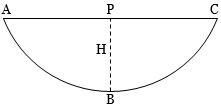
$A$ simple pendulum with a bob of mass $m$ oscillates from $A$ to $C$ and back to $A$ such that $PB$ is $H$. If the acceleration due to gravity is $g$,then the velocity of the bob as it passes through $B$ is

figure

(A)
$mgH$
(B)
$\sqrt{2gH}$
(C)
$\sqrt{gH}$
(D)
Zero
Show answer & solution
Verified Answer & Solution Locked
Sign in to your free student account to reveal verified answers and step-by-step solutions.
Sign in to view

1994 (213 questions)

Q1.

The equation $2x^2 + 3y^2 - 8x - 18y + 35 = k$ represents:

(A)
No locus if $k \gt 0$
(B)
An ellipse if $k \lt 0$
(C)
$A$ point if $k = 0$
(D)
$A$ hyperbola if $k \gt 0$
Show answer & solution
Verified Answer & Solution Locked
Sign in to your free student account to reveal verified answers and step-by-step solutions.
Sign in to view
Q2.

The table shown below gives the bond dissociation energies $E_{diss}$ for single covalent bonds of carbon $C$ atoms with elements $A, B, C$ and $D.$ Which element has the smallest atoms?

$Bond$ $E_{diss} (kJ \ mol^{-1})$
$C-A$ $240$
$C-B$ $328$
$C-C$ $276$
$C-D$ $485$

(A)
$A$
(B)
$B$
(C)
$C$
(D)
$D$
Show answer & solution
Verified Answer & Solution Locked
Sign in to your free student account to reveal verified answers and step-by-step solutions.
Sign in to view

1993 (244 questions)

Q1.

For $0 \lt \phi \lt \frac{\pi}{2}$,if $x = \sum_{n=0}^\infty \cos^{2n}\phi$,$y = \sum_{n=0}^\infty \sin^{2n}\phi$,and $z = \sum_{n=0}^\infty \cos^{2n}\phi \sin^{2n}\phi$,then:

(A)
$xyz = xz + y$
(B)
$xyz = xy + z$
(C)
$xyz = x + y + z$
(D)
$xyz = x + y$
Show answer & solution
Verified Answer & Solution Locked
Sign in to your free student account to reveal verified answers and step-by-step solutions.
Sign in to view
Q2.

Which of the following is of considerable economic importance?

(A)
Riccia
(B)
Funaria
(C)
Marchantia
(D)
Sphagnum
Show answer & solution
Verified Answer & Solution Locked
Sign in to your free student account to reveal verified answers and step-by-step solutions.
Sign in to view

1992 (286 questions)

Q1.

In which of the following plants,cotyledons form the first pair of leaves?

(A)
Maize
(B)
Castor
(C)
Rice
(D)
Bean
Show answer & solution
Verified Answer & Solution Locked
Sign in to your free student account to reveal verified answers and step-by-step solutions.
Sign in to view
Q2.

Epipetalous and syngenesious stamens occur in

(A)
Solanaceae
(B)
Brassicaceae
(C)
Fabaceae
(D)
Asteraceae
Show answer & solution
Verified Answer & Solution Locked
Sign in to your free student account to reveal verified answers and step-by-step solutions.
Sign in to view

1991 (185 questions)

Q1.

The vectors $\vec{A}$ and $\vec{B}$ are such that $|\vec{A}+\vec{B}|=|\vec{A}-\vec{B}|$. The angle between the two vectors is: (in $^{\circ}$)

(A)
$60$
(B)
$75$
(C)
$45$
(D)
$90$
Show answer & solution
Verified Answer & Solution Locked
Sign in to your free student account to reveal verified answers and step-by-step solutions.
Sign in to view
Q2.

The dimensional formula of permeability of free space $\mu_0$ is

(A)
$M^1 L^1 T^{-2} A^{-2}$
(B)
$M^1 L^1 T^{-2}$
(C)
$M^1 L^0 T^{-1}$
(D)
$M^1 L^1 T^2 A^{-1}$
Show answer & solution
Verified Answer & Solution Locked
Sign in to your free student account to reveal verified answers and step-by-step solutions.
Sign in to view

1990 (202 questions)

Q1.

An enthusiastic professor,wanting to demonstrate a physiological process,placed soaked mustard seeds in a glass jar and kept it in a corner before starting the lecture. At the end of the lecture,a sudden explosion occurred,and the glass jar shattered into pieces. Which of the following processes was the professor trying to demonstrate?

(A)
Diffusion
(B)
Osmosis
(C)
Anaerobic respiration
(D)
Imbibition
Show answer & solution
Verified Answer & Solution Locked
Sign in to your free student account to reveal verified answers and step-by-step solutions.
Sign in to view
Q2.

The maximum range of a gun on horizontal terrain is $16 \, km$. If $g = 10 \, m/s^2$,what must be the muzzle velocity of the shell in $m/s$?

(A)
$800$
(B)
$400$
(C)
$160$
(D)
$200\sqrt{2}$
Show answer & solution
Verified Answer & Solution Locked
Sign in to your free student account to reveal verified answers and step-by-step solutions.
Sign in to view

1989 (191 questions)

Q1.

If we use phenolphthalein as an indicator in a titration of $Na_2CO_3$ with $HCl$,the usual result is:

(A)
No visible change will occur
(B)
The indicator reacts with the acid
(C)
The indicator reacts with the base
(D)
Sodium chloride and carbonic acid will be formed
Show answer & solution
Verified Answer & Solution Locked
Sign in to your free student account to reveal verified answers and step-by-step solutions.
Sign in to view
Q2.

The pigment phytochrome is involved in:

(A)
Phototropism
(B)
Photorespiration
(C)
Photoperiodism
(D)
Geotropism
Show answer & solution
Verified Answer & Solution Locked
Sign in to your free student account to reveal verified answers and step-by-step solutions.
Sign in to view

1988 (157 questions)

Q1.

The cork cambium (phellogen) is formed from:

(A)
Phellogen
(B)
Vascular cambium
(C)
Phloem
(D)
Xylem
Show answer & solution
Verified Answer & Solution Locked
Sign in to your free student account to reveal verified answers and step-by-step solutions.
Sign in to view
Q2.

The dimensional formula for angular momentum is

(A)
$M{L^2}{T^{ - 2}}$
(B)
$M{L^2}{T^{ - 1}}$
(C)
$ML{T^{ - 1}}$
(D)
${M^0}{L^2}{T^{ - 2}}$
Show answer & solution
Verified Answer & Solution Locked
Sign in to your free student account to reveal verified answers and step-by-step solutions.
Sign in to view

1987 (44 questions)

Q1.

If $\frac{2x}{2x^2 + 5x + 2} \gt \frac{1}{x + 1}$,then

(A)
$-2 \gt x \gt -1$
(B)
$-2 \ge x \ge -1$
(C)
$-2 \lt x \lt -1$
(D)
$-2 \lt x \le -1$
Show answer & solution
Verified Answer & Solution Locked
Sign in to your free student account to reveal verified answers and step-by-step solutions.
Sign in to view
Q2.

The bond between carbon atom $(1)$ and carbon atom $(2)$ in compound $N \equiv C - CH = CH_2$ involves the hybridised carbon as

(A)
$sp^2$ and $sp^2$
(B)
$sp^3$ and $sp$
(C)
$sp$ and $sp^2$
(D)
$sp$ and $sp$
Show answer & solution
Verified Answer & Solution Locked
Sign in to your free student account to reveal verified answers and step-by-step solutions.
Sign in to view

1986 (53 questions)

Q1.

The atmosphere is held to the earth by

(A)
Winds
(B)
Gravity
(C)
Clouds
(D)
None of the above
Show answer & solution
Verified Answer & Solution Locked
Sign in to your free student account to reveal verified answers and step-by-step solutions.
Sign in to view
Q2.

The equation of the line passing through the points of intersection of the circles $3x^2 + 3y^2 - 2x + 12y - 9 = 0$ and $x^2 + y^2 + 6x + 2y - 15 = 0$ is

(A)
$10x - 3y - 18 = 0$
(B)
$10x + 3y - 18 = 0$
(C)
$10x + 3y + 18 = 0$
(D)
None of these
Show answer & solution
Verified Answer & Solution Locked
Sign in to your free student account to reveal verified answers and step-by-step solutions.
Sign in to view

1985 (56 questions)

Q1.

The molecules of a given mass of a gas have a $r.m.s.$ velocity of $200 \, m/s$ at $27^{\circ}C$ and $1.0 \times 10^5 \, N/m^2$ pressure. When the temperature is $127^{\circ}C$ and pressure is $0.5 \times 10^5 \, N/m^2$,the $r.m.s.$ velocity in $m/s$ will be

(A)
$\frac{100\sqrt{2}}{3}$
(B)
$100\sqrt{2}$
(C)
$\frac{400}{\sqrt{3}}$
(D)
None of the above
Show answer & solution
Verified Answer & Solution Locked
Sign in to your free student account to reveal verified answers and step-by-step solutions.
Sign in to view
Q2.

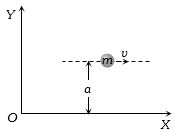
$A$ mass $m$ is moving with a constant velocity $v$ along a line parallel to the $X$-axis. Its angular momentum with respect to the origin or the $Z$-axis is:

figure

(A)
will be zero
(B)
will remain constant
(C)
will increase
(D)
will decrease
Show answer & solution
Verified Answer & Solution Locked
Sign in to your free student account to reveal verified answers and step-by-step solutions.
Sign in to view

1984 (62 questions)

Q1.

The equations of two equal sides of an isosceles triangle are $7x - y + 3 = 0$ and $x + y - 3 = 0$. If the third side passes through the point $(1, -10)$,then the equation of the third side is:

(A)
$y = \sqrt{3}x + 9$ but not $y = -\sqrt{3}x + 9$
(B)
$3x + y + 7 = 0$ but not $3x + y - 7 = 0$
(C)
$3x + y + 7 = 0$ or $x - 3y - 31 = 0$
(D)
Neither $3x + y + 7 = 0$ nor $x - 3y - 31 = 0$
Show answer & solution
Verified Answer & Solution Locked
Sign in to your free student account to reveal verified answers and step-by-step solutions.
Sign in to view
Q2.

The $IUPAC$ name of $(CH_3)_3C-CH=CH_2$ is

(A)
$3,3,3-$trimethylprop$-1-$ene
(B)
$1,1,1-$trimethylprop$-2-$ene
(C)
$3,3-$dimethylbut$-1-$ene
(D)
$2,2-$dimethylbut$-3-$ene
Show answer & solution
Verified Answer & Solution Locked
Sign in to your free student account to reveal verified answers and step-by-step solutions.
Sign in to view

1983 (64 questions)

Q1.

$A$ student has identified a triploblastic,coelomate,segmented animal as an arthropod. Which additional character should the student have verified before identifying that animal as an arthropod?

(A)
Presence of wings
(B)
Presence of jointed appendages
(C)
Type of coelom
(D)
Type of symmetry
Show answer & solution
Verified Answer & Solution Locked
Sign in to your free student account to reveal verified answers and step-by-step solutions.
Sign in to view
Q2.

Two atoms have the same atomic mass but different atomic numbers. Such atoms are called as:

(A)
Isotopes
(B)
Isobars
(C)
Isomer
(D)
Isoelectronic
Show answer & solution
Verified Answer & Solution Locked
Sign in to your free student account to reveal verified answers and step-by-step solutions.
Sign in to view

1982 (73 questions)

Q1.

What is the normality of a $1 \, M$ solution of $H_3PO_4$?

(A)
$0.5$
(B)
$1$
(C)
$2$
(D)
$3$
Show answer & solution
Verified Answer & Solution Locked
Sign in to your free student account to reveal verified answers and step-by-step solutions.
Sign in to view
Q2.

Find the total number of $9$ digit numbers which have all the digits different.

(A)
$9 \times 9!$
(B)
$9!$
(C)
$10!$
(D)
None of these
Show answer & solution
Verified Answer & Solution Locked
Sign in to your free student account to reveal verified answers and step-by-step solutions.
Sign in to view

1981 (54 questions)

Q1.

Two tangents $PQ$ and $PR$ are drawn to the circle $x^2 + y^2 - 2x - 4y - 20 = 0$ from the point $P(16, 7)$. If the centre of the circle is $C$,then the area of quadrilateral $PQCR$ is ............ $sq. \text{ units}$.

(A)
$75$
(B)
$150$
(C)
$15$
(D)
None of these
Show answer & solution
Verified Answer & Solution Locked
Sign in to your free student account to reveal verified answers and step-by-step solutions.
Sign in to view
Q2.

The equation $\frac{x^2}{1 - r} - \frac{y^2}{1 + r} = 1$ for $r \gt 1$ represents:

(A)
An ellipse
(B)
$A$ hyperbola
(C)
$A$ circle
(D)
An imaginary ellipse
Show answer & solution
Verified Answer & Solution Locked
Sign in to your free student account to reveal verified answers and step-by-step solutions.
Sign in to view

1980 (67 questions)

Q1.

$A$ wire of length $L$ and radius $r$ is rigidly fixed at one end. On stretching the other end of the wire with a force $F$,the increase in its length is $l$. If another wire of same material but of length $2L$ and radius $2r$ is stretched with a force of $2F$,the increase in its length will be

(A)
$l$
(B)
$2l$
(C)
$\frac{l}{2}$
(D)
$\frac{l}{4}$
Show answer & solution
Verified Answer & Solution Locked
Sign in to your free student account to reveal verified answers and step-by-step solutions.
Sign in to view
Q2.

If ${x^2} + px + 1$ is a factor of the expression $a{x^3} + bx + c$,then

(A)
${a^2} + {c^2} = - ab$
(B)
${a^2} - {c^2} = - ab$
(C)
${a^2} - {c^2} = ab$
(D)
None of these
Show answer & solution
Verified Answer & Solution Locked
Sign in to your free student account to reveal verified answers and step-by-step solutions.
Sign in to view

1979 (23 questions)

Q1.

If $\cos(\alpha + \beta) = \frac{4}{5}$ and $\sin(\alpha - \beta) = \frac{5}{13}$,where $0 \le \alpha, \beta \le \frac{\pi}{4}$,then $\tan 2\alpha =$

(A)
$\frac{16}{63}$
(B)
$\frac{56}{33}$
(C)
$\frac{28}{33}$
(D)
None of these
Show answer & solution
Verified Answer & Solution Locked
Sign in to your free student account to reveal verified answers and step-by-step solutions.
Sign in to view
Q2.

The points $(-a, -b)$,$(0, 0)$,$(a, b)$,and $(a^2, ab)$ are

(A)
Collinear
(B)
Vertices of a rectangle
(C)
Vertices of a parallelogram
(D)
None of these
Show answer & solution
Verified Answer & Solution Locked
Sign in to your free student account to reveal verified answers and step-by-step solutions.
Sign in to view

1978 (12 questions)

Q1.

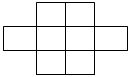
Six '$X$'s have to be placed in the squares of the figure such that each row contains at least one '$X$'. In how many different ways can this be done?

figure

(A)
$28$
(B)
$27$
(C)
$26$
(D)
None of these
Show answer & solution
Verified Answer & Solution Locked
Sign in to your free student account to reveal verified answers and step-by-step solutions.
Sign in to view
Q2.

If $x = a + b$,$y = a\alpha + b\beta$,and $z = a\beta + b\alpha$,where $\alpha$ and $\beta$ are complex cube roots of unity,then $xyz$ =

(A)
$a^2 + b^2$
(B)
$a^3 + b^3$
(C)
$a^3b^3$
(D)
$a^3 - b^3$
Show answer & solution
Verified Answer & Solution Locked
Sign in to your free student account to reveal verified answers and step-by-step solutions.
Sign in to view

1977 (12 questions)

Q1.

For every natural number $n$,${3^{2n + 2}} - 8n - 9$ is divisible by

(A)
$16$
(B)
$128$
(C)
$256$
(D)
None of these
Show answer & solution
Verified Answer & Solution Locked
Sign in to your free student account to reveal verified answers and step-by-step solutions.
Sign in to view
Q2.

$A$ straight line moves such that the sum of the reciprocals of its intercepts on two perpendicular lines is constant. Then the line always passes through:

(A)
$A$ fixed point
(B)
$A$ variable point
(C)
Origin
(D)
None of these
Show answer & solution
Verified Answer & Solution Locked
Sign in to your free student account to reveal verified answers and step-by-step solutions.
Sign in to view

1976 (11 questions)

Q1.

The points on the line $x + y = 4$ which lie at a unit distance from the line $4x + 3y = 10$ are

(A)
$(3, 1), (-7, 11)$
(B)
$(3, 1), (7, 11)$
(C)
$(-3, 1), (-7, 11)$
(D)
$(1, 3), (-7, 11)$
Show answer & solution
Verified Answer & Solution Locked
Sign in to your free student account to reveal verified answers and step-by-step solutions.
Sign in to view
Q2.

Numbers greater than $1000$ but not greater than $4000$ which can be formed with the digits $0, 1, 2, 3, 4$ (repetition of digits is allowed),are

(A)
$350$
(B)
$375$
(C)
$450$
(D)
$576$
Show answer & solution
Verified Answer & Solution Locked
Sign in to your free student account to reveal verified answers and step-by-step solutions.
Sign in to view

1975 (14 questions)

Q1.

In how many ways can $5$ boys and $5$ girls sit in a circle so that no two boys sit together?

(A)
$5! \times 5!$
(B)
$4! \times 5!$
(C)
$\frac{5! \times 5!}{2}$
(D)
None of these
Show answer & solution
Verified Answer & Solution Locked
Sign in to your free student account to reveal verified answers and step-by-step solutions.
Sign in to view
Q2.

To double the volume of a given mass of an ideal gas at $27^{\circ}C$ keeping the pressure constant,one must raise the temperature in degrees Celsius to ....... $^{\circ}C$.

(A)
$54$
(B)
$270$
(C)
$327$
(D)
$600$
Show answer & solution
Verified Answer & Solution Locked
Sign in to your free student account to reveal verified answers and step-by-step solutions.
Sign in to view

1974 (9 questions)

Q1.

$\tan 20^\circ \tan 40^\circ \tan 60^\circ \tan 80^\circ =$

(A)
$1$
(B)
$2$
(C)
$3$
(D)
$\sqrt{3}/2$
Show answer & solution
Verified Answer & Solution Locked
Sign in to your free student account to reveal verified answers and step-by-step solutions.
Sign in to view
Q2.

The equation of the lines which pass through the point $(3, -2)$ and are inclined at $60^o$ to the line $\sqrt{3}x + y = 1$ is:

(A)
$y + 2 = 0, \sqrt{3}x - y - 2 - 3\sqrt{3} = 0$
(B)
$x - 2 = 0, \sqrt{3}x - y + 2 + 3\sqrt{3} = 0$
(C)
$\sqrt{3}x - y - 2 - 3\sqrt{3} = 0$
(D)
None of these
Show answer & solution
Verified Answer & Solution Locked
Sign in to your free student account to reveal verified answers and step-by-step solutions.
Sign in to view

1973 (10 questions)

Q1.

The equation of the base of an equilateral triangle is $x + y = 2$ and the vertex is $(2, -1)$. The length of the side of the triangle is

(A)
$\sqrt{3/2}$
(B)
$\sqrt{2}$
(C)
$\sqrt{2/3}$
(D)
None of these
Show answer & solution
Verified Answer & Solution Locked
Sign in to your free student account to reveal verified answers and step-by-step solutions.
Sign in to view
Q2.

The number of ways in which five identical balls can be distributed among ten identical boxes such that no box contains more than one ball is:

(A)
$10!$
(B)
$\frac{10!}{5!}$
(C)
$\frac{10!}{(5!)^2}$
(D)
None of these
Show answer & solution
Verified Answer & Solution Locked
Sign in to your free student account to reveal verified answers and step-by-step solutions.
Sign in to view

1972 (4 questions)

Q1.

If $n$ is an integer greater than $1$,then $a - ^nC_1(a - 1) + ^nC_2(a - 2) + \dots + (-1)^n(a - n) =$

(A)
$a$
(B)
$0$
(C)
$a^2$
(D)
$2^n$
Show answer & solution
Verified Answer & Solution Locked
Sign in to your free student account to reveal verified answers and step-by-step solutions.
Sign in to view
Q2.

If $x = -5 + 2\sqrt{-4}$,then the value of the expression $x^4 + 9x^3 + 35x^2 - x + 4$ is

(A)
$160$
(B)
$-160$
(C)
$60$
(D)
$-60$
Show answer & solution
Verified Answer & Solution Locked
Sign in to your free student account to reveal verified answers and step-by-step solutions.
Sign in to view

1971 (6 questions)

Q1.

The equation of the circle whose diameter is the line segment joining the points $(-4, 3)$ and $(12, -1)$ is:

(A)
$x^2 + y^2 + 8x + 2y + 51 = 0$
(B)
$x^2 + y^2 + 8x - 2y - 51 = 0$
(C)
$x^2 + y^2 + 8x + 2y - 51 = 0$
(D)
$x^2 + y^2 - 8x - 2y - 51 = 0$
Show answer & solution
Verified Answer & Solution Locked
Sign in to your free student account to reveal verified answers and step-by-step solutions.
Sign in to view
Q2.

$A$ line $4x + y = 1$ passes through the point $A(2, -7)$ and meets the line $BC$,whose equation is $3x - 4y + 1 = 0$,at the point $B$. The equation of the line $AC$ such that $AB = AC$ is

(A)
$52x + 89y + 519 = 0$
(B)
$52x + 89y - 519 = 0$
(C)
$89x + 52y + 519 = 0$
(D)
$89x + 52y - 519 = 0$
Show answer & solution
Verified Answer & Solution Locked
Sign in to your free student account to reveal verified answers and step-by-step solutions.
Sign in to view

1970 (6 questions)

Q1.

If $A, B, C, D$ are the angles of a cyclic quadrilateral,then $\cos A + \cos B + \cos C + \cos D =$

(A)
$2(\cos A + \cos C)$
(B)
$2(\cos A + \cos B)$
(C)
$2(\cos A + \cos D)$
(D)
$0$
Show answer & solution
Verified Answer & Solution Locked
Sign in to your free student account to reveal verified answers and step-by-step solutions.
Sign in to view
Q2.

$A$ spherical balloon of radius $r$ subtends an angle $\alpha$ at the eye of an observer. If the angle of elevation of the centre of the balloon is $\beta$,then the height of the centre of the balloon is:

(A)
$r \csc\left(\frac{\alpha}{2}\right) \sin \beta$
(B)
$r \csc \alpha \sin\left(\frac{\beta}{2}\right)$
(C)
$r \sin\left(\frac{\alpha}{2}\right) \csc \beta$
(D)
$r \sin \alpha \csc\left(\frac{\beta}{2}\right)$
Show answer & solution
Verified Answer & Solution Locked
Sign in to your free student account to reveal verified answers and step-by-step solutions.
Sign in to view

1969 (4 questions)

Q1.

If $a^{1/x} = b^{1/y} = c^{1/z}$ and $a, b, c$ are in $G.P.$,then $x, y, z$ will be in

(A)
$A.P.$
(B)
$G.P.$
(C)
$H.P.$
(D)
None of these
Show answer & solution
Verified Answer & Solution Locked
Sign in to your free student account to reveal verified answers and step-by-step solutions.
Sign in to view
Q2.

If $x$ is real,the expression $\frac{x + 2}{2x^2 + 3x + 6}$ takes all values in the interval

(A)
$\left( \frac{1}{13}, \frac{1}{3} \right)$
(B)
$\left[ -\frac{1}{13}, \frac{1}{3} \right]$
(C)
$\left( -\frac{1}{3}, \frac{1}{13} \right)$
(D)
None of these
Show answer & solution
Verified Answer & Solution Locked
Sign in to your free student account to reveal verified answers and step-by-step solutions.
Sign in to view

1968 (5 questions)

Q1.

The quadratic equation in $t$,such that the $A.M.$ of its roots is $A$ and the $G.M.$ of its roots is $G$,is

(A)
$t^2 - 2At + G^2 = 0$
(B)
$t^2 - 2At - G^2 = 0$
(C)
$t^2 + 2At + G^2 = 0$
(D)
None of these
Show answer & solution
Verified Answer & Solution Locked
Sign in to your free student account to reveal verified answers and step-by-step solutions.
Sign in to view
Q2.

If a root of the equation $ax^2 + bx + c = 0$ is the reciprocal of a root of the equation $a'x^2 + b'x + c' = 0$,then:

(A)
$(cc' - aa')^2 = (ba' - cb')(ab' - bc')$
(B)
$(bb' - aa')^2 = (ca' - bc')(ab' - bc')$
(C)
$(cc' - aa')^2 = (ba' + cb')(ab' + bc')$
(D)
None of these
Show answer & solution
Verified Answer & Solution Locked
Sign in to your free student account to reveal verified answers and step-by-step solutions.
Sign in to view

1967 (7 questions)

Q1.

The coefficient of $x^{-7}$ in the expansion of $\left( ax - \frac{1}{bx^2} \right)^{11}$ is

(A)
$\frac{462a^5}{b^6}$
(B)
$\frac{462a^6}{b^5}$
(C)
$\frac{-462a^5}{b^6}$
(D)
$\frac{-462a^6}{b^5}$
Show answer & solution
Verified Answer & Solution Locked
Sign in to your free student account to reveal verified answers and step-by-step solutions.
Sign in to view
Q2.

If the roots of the equation $\frac{1}{x + p} + \frac{1}{x + q} = \frac{1}{r}$ are equal in magnitude but opposite in sign,then the product of the roots will be

(A)
$\frac{p^2 + q^2}{2}$
(B)
$-\frac{p^2 + q^2}{2}$
(C)
$\frac{p^2 - q^2}{2}$
(D)
$-\frac{p^2 - q^2}{2}$
Show answer & solution
Verified Answer & Solution Locked
Sign in to your free student account to reveal verified answers and step-by-step solutions.
Sign in to view

1966 (8 questions)

Q1.

$\sqrt{2} + \sqrt{3} + \sqrt{4} + \sqrt{6}$ is equal to

(A)
$\cot(7\frac{1}{2}^{\circ})$
(B)
$\sin(7\frac{1}{2}^{\circ})$
(C)
$\sin(15^{\circ})$
(D)
$\cos(15^{\circ})$
Show answer & solution
Verified Answer & Solution Locked
Sign in to your free student account to reveal verified answers and step-by-step solutions.
Sign in to view
Q2.

If $(1 + x)^{15} = C_0 + C_1x + C_2x^2 + ...... + C_{15}x^{15},$ then $C_2 + 2C_3 + 3C_4 + .... + 14C_{15} =$

(A)
$14 \cdot 2^{14}$
(B)
$13 \cdot 2^{14} + 1$
(C)
$13 \cdot 2^{14} - 1$
(D)
None of these
Show answer & solution
Verified Answer & Solution Locked
Sign in to your free student account to reveal verified answers and step-by-step solutions.
Sign in to view

1965 (8 questions)

Q1.

If $\omega$ is a cube root of unity,then the value of $(1 - \omega + \omega^2)^5 + (1 + \omega - \omega^2)^5$ is:

(A)
$16$
(B)
$32$
(C)
$48$
(D)
$-32$
Show answer & solution
Verified Answer & Solution Locked
Sign in to your free student account to reveal verified answers and step-by-step solutions.
Sign in to view
Q2.

An aeroplane flying horizontally $1 \ km$ above the ground is observed at an elevation of $60^\circ$ and after $10$ seconds the elevation is observed to be $30^\circ$. The uniform speed of the aeroplane in $km/h$ is

(A)
$240$
(B)
$240\sqrt{3}$
(C)
$60\sqrt{3}$
(D)
None of these
Show answer & solution
Verified Answer & Solution Locked
Sign in to your free student account to reveal verified answers and step-by-step solutions.
Sign in to view

1964 (5 questions)

Q1.

If the vertices of a triangle are $(2, 1), (5, 2)$ and $(3, 4)$,then its circumcentre is

(A)
$\left( \frac{13}{2}, \frac{9}{2} \right)$
(B)
$\left( \frac{13}{4}, \frac{9}{4} \right)$
(C)
$\left( \frac{9}{4}, \frac{13}{4} \right)$
(D)
None of these
Show answer & solution
Verified Answer & Solution Locked
Sign in to your free student account to reveal verified answers and step-by-step solutions.
Sign in to view
Q2.

$A$ vertical pole consists of two parts,the lower part being one third of the whole. At a point in the horizontal plane through the base of the pole and at a distance of $20 \, m$ from it,the upper part of the pole subtends an angle whose tangent is $\frac{1}{2}$. The possible heights of the pole are

(A)
$20 \, m$ and $20\sqrt{3} \, m$
(B)
$20 \, m$ and $60 \, m$
(C)
$16 \, m$ and $48 \, m$
(D)
None of these
Show answer & solution
Verified Answer & Solution Locked
Sign in to your free student account to reveal verified answers and step-by-step solutions.
Sign in to view

1963 (5 questions)

Q1.

If $\sec x \cos 5x + 1 = 0$,where $0 \lt x \lt 2\pi$,then $x =$

(A)
$\frac{\pi}{6}, \frac{3\pi}{6}, \dots$
(B)
$\frac{\pi}{5}$
(C)
$\frac{\pi}{4}, \frac{3\pi}{4}, \frac{5\pi}{4}, \frac{7\pi}{4}$
(D)
None of these
Show answer & solution
Verified Answer & Solution Locked
Sign in to your free student account to reveal verified answers and step-by-step solutions.
Sign in to view
Q2.

If $\sec 4\theta - \sec 2\theta = 2$,then the general value of $\theta$ is

(A)
$(2n + 1)\frac{\pi}{4}$
(B)
$(2n + 1)\frac{\pi}{10}$
(C)
$n\pi + \frac{\pi}{2}$ or $\frac{n\pi}{5} + \frac{\pi}{10}$
(D)
None of these
Show answer & solution
Verified Answer & Solution Locked
Sign in to your free student account to reveal verified answers and step-by-step solutions.
Sign in to view

1962 (4 questions)

Q1.

The sum of $n$ terms of the following series $1 + (1 + x) + (1 + x + x^2) + \dots$ will be

(A)
$\frac{1 - x^n}{1 - x}$
(B)
$\frac{x(1 - x^n)}{1 - x}$
(C)
$\frac{n(1 - x) - x(1 - x^n)}{(1 - x)^2}$
(D)
None of these
Show answer & solution
Verified Answer & Solution Locked
Sign in to your free student account to reveal verified answers and step-by-step solutions.
Sign in to view
Q2.

The vertices of a triangle are $(2, 1)$,$(5, 2)$ and $(4, 4)$. The lengths of the perpendiculars from these vertices to the opposite sides are

(A)
$\frac{7}{\sqrt{5}}, \frac{7}{\sqrt{13}}, \frac{7}{\sqrt{6}}$
(B)
$\frac{7}{\sqrt{6}}, \frac{7}{\sqrt{8}}, \frac{7}{\sqrt{10}}$
(C)
$\frac{7}{\sqrt{5}}, \frac{7}{\sqrt{8}}, \frac{7}{\sqrt{15}}$
(D)
$\frac{7}{\sqrt{5}}, \frac{7}{\sqrt{13}}, \frac{7}{\sqrt{10}}$
Show answer & solution
Verified Answer & Solution Locked
Sign in to your free student account to reveal verified answers and step-by-step solutions.
Sign in to view

1961 (2 questions)

Q1.

If the line segment joining the points $A(a, b)$ and $B(c, d)$ subtends an angle $\theta$ at the origin,then $\cos \theta$ is equal to

(A)
$\frac{ab + cd}{\sqrt{(a^2 + b^2)(c^2 + d^2)}}$
(B)
$\frac{ac + bd}{\sqrt{(a^2 + b^2)(c^2 + d^2)}}$
(C)
$\frac{ac - bd}{\sqrt{(a^2 + b^2)(c^2 + d^2)}}$
(D)
None of these
Show answer & solution
Verified Answer & Solution Locked
Sign in to your free student account to reveal verified answers and step-by-step solutions.
Sign in to view
Q2.

If $O$ is the origin and the coordinates of any two points $Q_1$ and $Q_2$ are $(x_1, y_1)$ and $(x_2, y_2)$ respectively,then $OQ_1 \cdot OQ_2 \cos \angle Q_1OQ_2 =$

(A)
$x_1x_2 - y_1y_2$
(B)
$x_1y_1 - x_2y_2$
(C)
$x_1x_2 + y_1y_2$
(D)
$x_1y_1 + x_2y_2$
Show answer & solution
Verified Answer & Solution Locked
Sign in to your free student account to reveal verified answers and step-by-step solutions.
Sign in to view

1960 (2 questions)

Q1.

If $A(6, 3)$,$B(-3, 5)$,$C(4, -2)$,and $D(x, 3x)$ are four points. If the ratio of the area of $\Delta DBC$ and $\Delta ABC$ is $1 : 2$,then the value of $x$ is:

(A)
$\frac{11}{8}$
(B)
$\frac{8}{11}$
(C)
$3$
(D)
$\text{None of these}$
Show answer & solution
Verified Answer & Solution Locked
Sign in to your free student account to reveal verified answers and step-by-step solutions.
Sign in to view
Q2.

Find the value of $\frac{18^3 + 7^3 + 3 \times 18 \times 7 \times 25}{3^6 + 6 \times 243 \times 2 + 15 \times 81 \times 4 + 20 \times 27 \times 8 + 15 \times 9 \times 16 + 6 \times 3 \times 32 + 64}$

(A)
$1$
(B)
$5$
(C)
$25$
(D)
$100$
Show answer & solution
Verified Answer & Solution Locked
Sign in to your free student account to reveal verified answers and step-by-step solutions.
Sign in to view
All Years Protected

Want All 58391 Class 11 PYQs?

Sign up free to unlock every previous year question paper with detailed solutions, practice in timed exam mode, and evaluate your rank.

Ready to practice Class 11 PYQs?

Sign up free to unlock every previous year question and generate papers from them.