Engineer & Medical

Chemical Kinetics question bank (Chemistry)

Practice 1,557 free Engineer & Medical Chemistry - Chemical Kinetics questions with answers and step-by-step solutions.

Q1.

$\mathrm{A} \longrightarrow \mathrm{B}$ (first reaction)
$\mathrm{C} \longrightarrow \mathrm{D}$ (second reaction)
Consider the above two first-order reactions. The rate constant for first reaction at 500 K is double of the same at 300 K. At $500 \mathrm{~K}, 50 \%$ of the reaction becomes complete in 2 hour. The activation energy of the second reaction is half of that of first reaction. If the rate constant at 500 K of the second reaction becomes double of the rate constant of first reaction at the same temperature; then rate constant for the second reaction at 300 K is $\_\_\_\_$ $\times 10^{-1}$ hour $^{-1}$ (nearest integer).

Show answer & solution
Verified Answer & Solution Locked
Sign in to your free student account to reveal verified answers, instant hints, and detailed explanations.
Sign in to view
Q2.

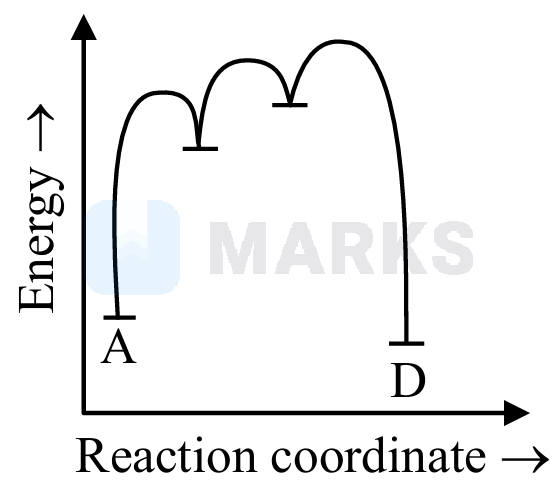
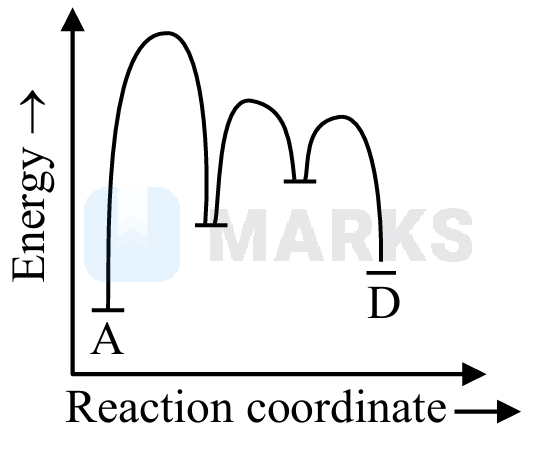
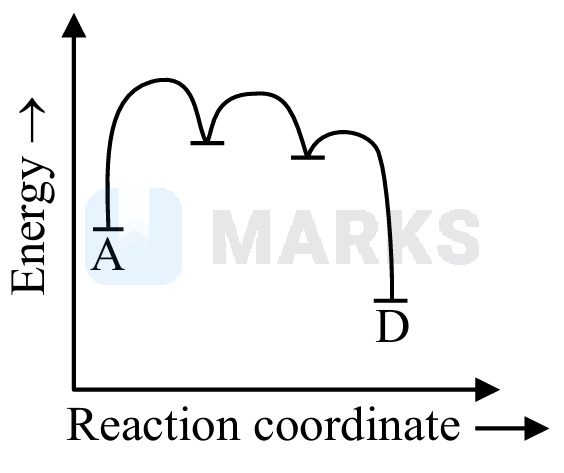
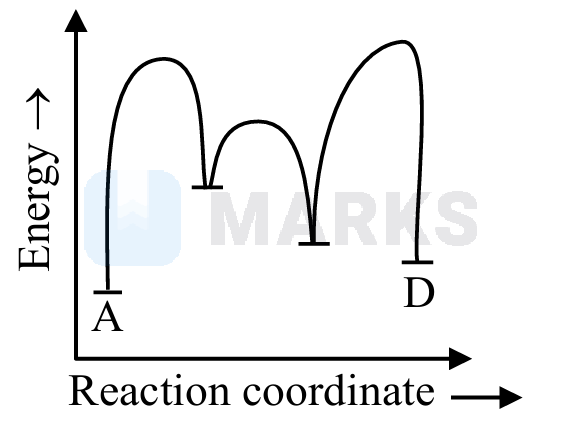
Reactant A converts to product D through the given mechanism (with the net evolution of heat) :
$\mathrm{A} \rightarrow \mathrm{B} \quad$ slow $; \Delta \mathrm{H}=+\mathrm{ve}$
$\mathrm{B} \rightarrow \mathrm{C}$ fast; $\Delta \mathrm{H}=-\mathrm{ve}$
$\mathrm{C} \rightarrow \mathrm{D} \quad$ fast ; $\Delta \mathrm{H}=-\mathrm{ve}$
Which of the following represents the above reaction mechanism?

(A)
(B)
(C)
(D)
Show answer & solution
Verified Answer & Solution Locked
Sign in to your free student account to reveal verified answers, instant hints, and detailed explanations.
Sign in to view
Protected Questions

Unlock All 138 Questions in Chemical Kinetics

Log in or sign up free to access every question with complete solutions, create chapter practice tests, and track your performance.

Sign up free to access all 138 questions

Unlock every Chemical Kinetics question, generate papers, and practice at your own pace.