Engineer & Medical

Kinetic Theory of Gases question bank (Physics)

Practice 745 free Engineer & Medical Physics - Kinetic Theory of Gases questions with answers and step-by-step solutions.

Q1.

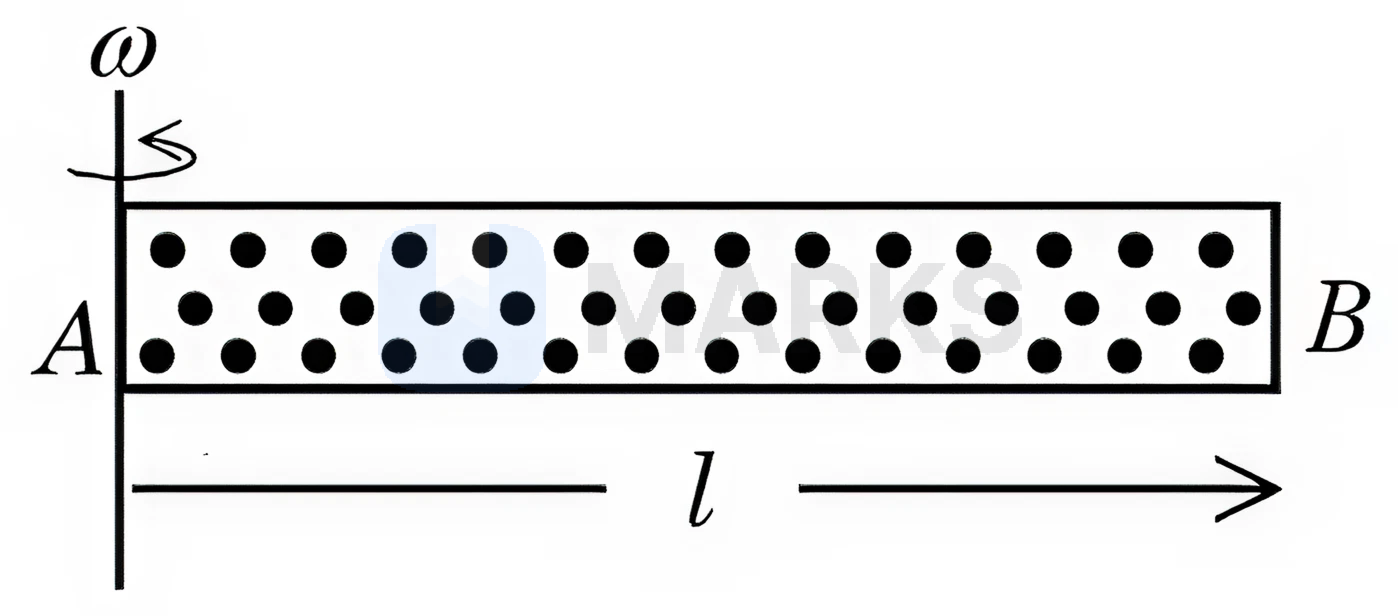
A cylindrical tube $A B$ of length $l$, closed at both ends contains an ideal gas of 1 mol having molecular weight $M$. The tube is rotated in a horizontal plane with constant angular velocity $\omega$ about an axis perpendicular to $A B$ and passing through the edge at end $A$, as shown in the figure. If $P_{A}$ and $P_{B}$ are the pressures at $A$ and $B$ respectively, then (Consider the temperature is same at all points in the tube)
(A)
$P_{B}=P_{A}$
(B)
$P_{B}=P_{A} \exp \left(M \omega^{2} l^{2} / 3 R T\right)$
(C)
$P_{B}=P_{A} \exp \left(M \omega^{2} l^{2} / R T\right)$
(D)
$P_{B}=P_{A} \exp \left(M \omega^{2} l^{2} / 2 R T\right)$
Show answer & solution
Verified Answer & Solution Locked
Sign in to your free student account to reveal verified answers, instant hints, and detailed explanations.
Sign in to view
Q2.

During an adiabatic process, if the pressure of a gas is found to be proportional to the cube of its absolute temperature, then the ratio of $\frac{C_{\mathrm{P}}}{\mathrm{C}_{\mathrm{V}}}$ for the gas is :

(A)
$\frac{5}{3}$
(B)
$\frac{9}{7}$
(C)
$\frac{3}{2}$
(D)
$\frac{7}{5}$
Show answer & solution
Verified Answer & Solution Locked
Sign in to your free student account to reveal verified answers, instant hints, and detailed explanations.
Sign in to view
Protected Questions

Unlock All 47 Questions in Kinetic Theory of Gases

Log in or sign up free to access every question with complete solutions, create chapter practice tests, and track your performance.

Sign up free to access all 47 questions

Unlock every Kinetic Theory of Gases question, generate papers, and practice at your own pace.