MHT-CET

Motion In One Dimension question bank (Physics)

Practice 59 free MHT-CET Physics - Motion In One Dimension questions with answers and step-by-step solutions.

Q1.

A train accelerates from rest at a constant rate 'p' for some time (attains velocity 'v') and then retards to rest at the constant rate 'q'. If the total distance covered by the train is 's', then the velocity 'v' of the train is

(A)
$\left( \left( \dfrac{p+q}{2pq} \right) \times s \right)^{\frac{1}{2}}$
(B)
$\left( \left( \dfrac{p-q}{2pq} \right) \times s \right)^{\frac{1}{2}}$
(C)
$\left( \left( \dfrac{2pq}{p+q} \right) \times s \right)^{\frac{1}{2}}$
(D)
$\left( \left( \dfrac{2pq}{p-q} \right) \times s \right)^{\frac{1}{2}}$
Show answer & solution
Verified Answer & Solution Locked
Sign in to your free student account to reveal verified answers, instant hints, and detailed explanations.
Sign in to view
Q2.

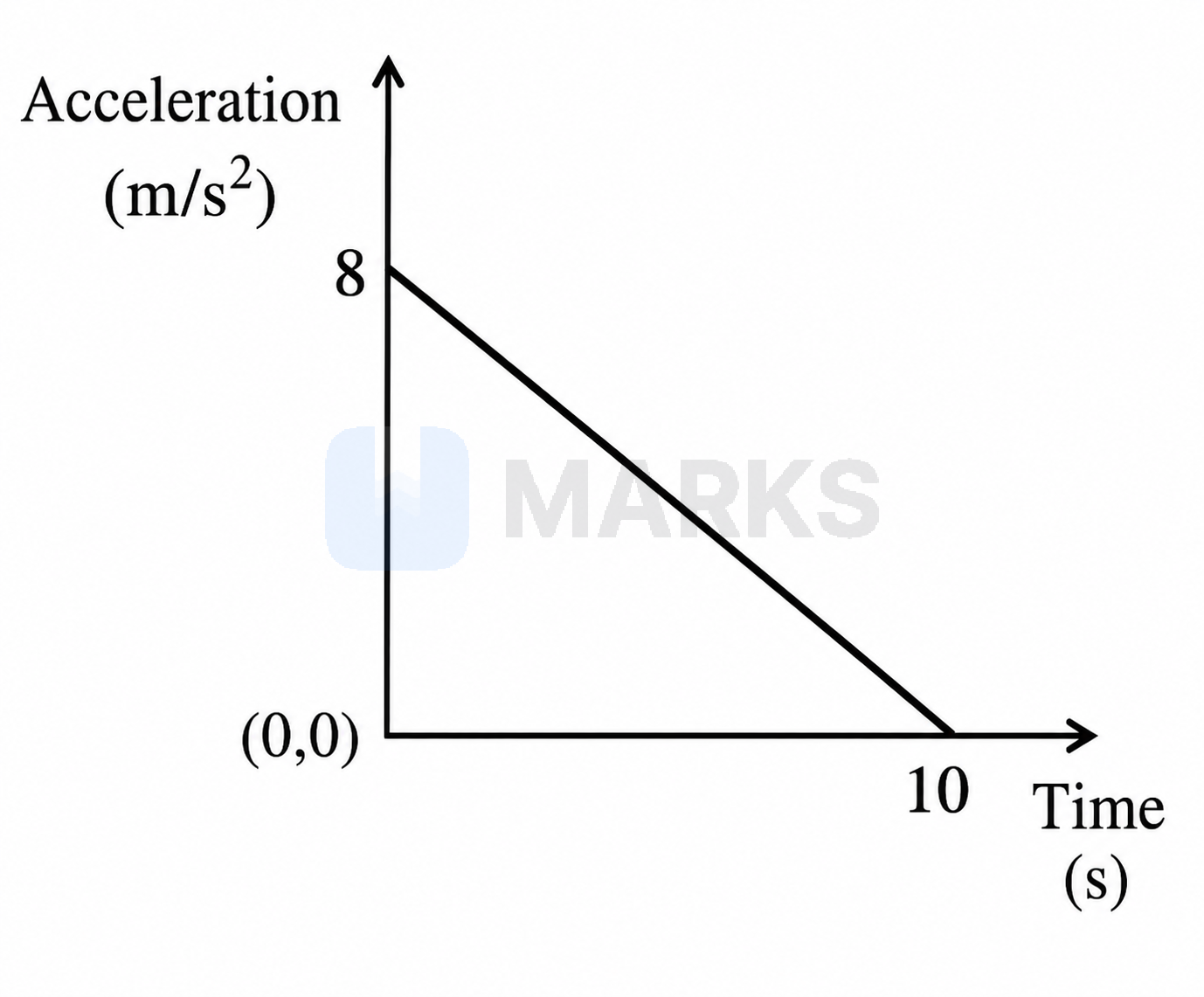
The acceleration ($a$) -time ($t$) graph for the body starting from rest is as shown in the figure. The maximum speed of the body is

(A)
$200\ \text{m/s}$
(B)
$160\ \text{m/s}$
(C)
$80\ \text{m/s}$
(D)
$40\ \text{m/s}$
Show answer & solution
Verified Answer & Solution Locked
Sign in to your free student account to reveal verified answers, instant hints, and detailed explanations.
Sign in to view
Protected Questions

Unlock All 32 Questions in Motion In One Dimension

Log in or sign up free to access every question with complete solutions, create chapter practice tests, and track your performance.

Sign up free to access all 32 questions

Unlock every Motion In One Dimension question, generate papers, and practice at your own pace.